

Comex is the Science of Meeting
Special series:
Comex from analog to digital: to remember the past, learn about the present, and reflect on the future!
Exclusive content about the path of Brazilian foreign trade!
Here at Allink, we are passionate about foreign trade, so we thought of something special to pay tribute to this unique science that is a fundamental part of the world's evolution.
This desire gave rise to this material, which brings together reports, research, and reflections on the evolution of foreign trade in Brazil from the computerization of processes to the present day and, as a bonus, some perspectives for the future.
Below you can embark on a unique journey, which brings information that you won't find on Google: visions and reports that come from the daily experience of doing foreign trade by professionals with a wealth of experience in the area!
Commanders of this journey:
Carla Vieira - Allink: The creator of this journey!
She has been working in foreign trade since 1998, working in several sectors. She has worked in the import, export, freight forwarder, brokerage, and dispatch segments, among others. She is currently responsible for marketing at Allink, a company where she has worked for 10 years. Carla was responsible for the conception and execution of the activities for the foreign trade week, including the interviews that resulted in this material.
Kátia Cristina Papacídio - KPC Consultoria: Impeccable mastery of hard and soft skills!
She is a foreign trade consultant and customs broker assistant. She has an MBA in project management from USP-ESALQ. She has worked in foreign trade for over 25 years. She was an import supervisor for 15 years at Servimex, for which she currently provides consulting and PO for IT projects related to the operation. She has extensive knowledge in the areas of customs clearance for imports, tax classification of goods and review of registration for the Siscomex Single Portal Product Catalog, special regimes, initial qualification, reactivation and review of estimates with Radar/Siscomex. She is a volunteer collaborator in the Sindasp working groups and other entities linked to the Private/Regulated Sector for Foreign Trade matters.
Why do we sail? Why do we move? Foreign trade is about the interaction between worlds. So, you cannot do trade without relationships. Our ship now floats at the meeting of waters! Do you feel the flow?
We have dedicated this week to talking about the evolution of foreign trade, the revolution that technology has brought to our ways of doing things, and the gigantic scale of the changes we have experienced in recent decades. However, as we have observed before, the human element is always at the center of the movement.
When we talk about human beings, we necessarily talk about relationships. We are animals completely incapable of surviving and developing alone. Unlike a baby horse, after birth, it takes us about a year to take our first steps. We live in society because we need each other.
Foreign trade is certainly one of the practices that is most dedicated to promoting the encounter and integration between worlds. Our area plays a fundamental role in human and social development. When we take a product or service from one point of the globe to another, we also take culture, knowledge, empathy and many other things.
That is why, if we are talking about the evolution of foreign trade, we need to go through relationships. In our practice, this involves several elements: laws, standards, policies and so on. To embark on this subject, we had the rich contribution of Kátia Papacidio, who works at KPC Consultoria and is a consultant for Allink. Let's talk?
The intermediate agent between manual and digital
Kátia began her career in foreign trade in the 1990s, as an office girl and soon after as an Import Assistant, and she experienced a long period of that artisanal foreign trade period. She reminds us that another difficulty at that time was the predominance of certain agencies in specific locations. Import guides, for example, depending on the type, needed to be registered with Decex in Rio de Janeiro.
The slow pace of the paper era added to the volume of activities and the time required for distances. Before and after digitalization, to deal with all the workload and stress that this generated, there was an 'intermediary agent', outsourced companies that offered services similar to what automation would do in the future:
“It was very stressful for us to be able to transfer the instructions and information from the process to paper and check it in time to submit it to the government departments. There were even outsourced companies involved to fill out the countless forms, because there was so much information, documents and processes that sometimes the shipping companies did not have the time or the systems to be able to do their own processes in a 100% manual format.”
On January 1, 1997, the first significant change occurred with the creation of Siscomex Orientador, replacing paper forms with the electronic model. Even with this advancement, intermediary agents continued to play an important role in alleviating the pile-up of tasks generated by bureaucracy and making it possible to meet established deadlines.
To this day, some situations persist that prolong the role of intermediaries. This is the case of the checks required for the shipping of products. Despite technological improvements, there are situations in which this step continues to be done manually , due to the lack of standardization and automation of certain procedures:
“Today, the issuance of the process has been streamlined, but the checking of documents prepared, such as LI, DI, DUE and the like, still exists in most brokers and, generally, these are manual checks. Someone there goes through each item with this function. It has not yet been 100% automated. I believe that with the advancement of the new import process, which includes the product catalog within the Single Portal, this will reduce the checking step.”
The product catalog will standardize the descriptions of products by the importer, preventing them from modifying these descriptions for each process. This action, explains Kátia, is essential to automate the checking. It is clear how much digital transformation still needs to advance , but what needs to be made even clearer is that this depends on other changes.
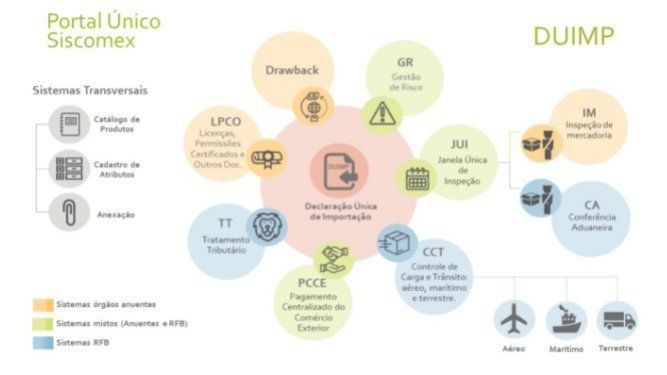
What the Siscomex Single Portal for Imports is expected to look like. (Source: www.siscomex.gov.br)
A network is not a straight line...
The automation of foreign trade processes involved advances beyond technique. The logic of digital is the network, integration , reducing bureaucracy, since simplifying is not just automating. Simplifying is about changing the way of thinking about how things are done, such as making processes more flexible, leaner, reducing steps , among other attitudes, which includes the need to change laws and regulations:
“One of the things I didn't mention, but which is very important to remember, is that with this change over the years, the interpersonal relationship between applicants and approving agencies has changed a lot. In the Siscomex Single Portal project, one of the goals is to reduce bureaucracy and speed up the process by decentralizing services and departments. The pandemic forced this to advance very quickly, so that services and process analyses were carried out digitally, online and in a decentralized way.”
This change has required tax auditors to adapt : they used to work with a specific niche and, with decentralization, began to deal with a greater diversity of products, processes and agencies to carry out their activities.
On the other hand, this new operation required the creation of risk management , which, as Kátia notes, makes it easier for auditors to analyze processes , as it signals the measures taken by companies to ensure compliance with standards, security procedures and so on. This was already on the horizon of AEOs.
Those who work with quality show the way
Many of the transformations implemented, underway or planned for the near future were already part of the discussions and actions of AEO companies. The acronym stands for Authorized Economic Operator and refers to a special regime granted through an international quality certification .
To obtain the certification, companies must meet certain criteria in two possible categories: security and compliance . Once they reach the qualification standards, these companies are certified as low-risk, reliable operators and therefore enjoy benefits offered by Brazilian Customs , related to greater speed and predictability of their cargo in international trade flows:
“A company certified as AEO guarantees to the Federal Revenue Service that it has security and quality standards and procedures through continuous monitoring of its operations. It guarantees that all parties operating in its chain are service providers that are also certified or duly monitored, and that it has traceability of everything that happens to its cargo [...]. With this, an AEO company already shows that it has controlled and monitored risk management.”
AEO certification points to something important for the evolution of foreign trade practices: quality in company management generates more trust and, consequently, contributes to less bureaucracy and greater agility in foreign trade.
Since nothing is perfect, everyone needs a plan B
And, speaking of risk management, Kátia raises another relevant point for the evolution of foreign trade processes. Digitalization involves, as we observed in the conversations in previous emails, the preparation and planning of people and activities. One of the requirements for the success of this transition is having a security plan that considers the specificities of the virtual world:
“Will this digital era be perfect and risk-free? Of course not! Recently we had a huge problem with Anvisa's systems due to a hacker attack. We went almost a week without being able to access their system and there was no plan B. There was no contingency plan. So today I think one of the challenges of the digital era for all parties will be developing these plans.”
Rethinking security is fundamental given the virtualization of procedures, especially regarding information. It is essential, including, to meet compliance requirements and existing legislation on the subject . On the other hand, certain aspects of legislation pose challenges of their own...
Technology cannot advance through closed paths
We need to follow the law and, think about it, bureaucracy exists precisely to ensure this correctness. However, if technology progresses and legislation does not change, we cannot apply the advances to work processes .
Regulatory and legislative review is necessary for case law to keep up with the changes, both nationally and internationally, since many laws date back decades, when things worked very differently:
“When we talk about reducing bureaucracy, we can't help but talk about changes in legislation. There is federal legislation that has been in force since the 1960s and that will now have to keep pace with the changing procedures.”
There is, for example, a request from AEO companies regarding a change to the taxable event and deadlines for paying federal and state taxes, which would allow, among other benefits, better cash flow management. This change is foreseen in the concept of Duimp and PCCE within the New Import Process. Along these lines, changing legislation is also a condition for all bodies involved in foreign trade to function more healthily .
Because foreign trade is done in a network
In this conversation with Kátia, it becomes clear that the evolution of foreign trade involves, in addition to technologies and process automation, a profound change in the relationship between parties. This transformation happens mainly through closer ties and dialogue, aiming at jointly building new ways of doing foreign trade. It was through this type of integrated action that the current improvements were built:
“In building the New Import Process, the Federal Revenue Service realized that it was not enough to talk only to Anvisa, MAPA, Sefaz and other members of the public sector. So, based on the feedback from the Public Consultations that began in 2014, numerous process mappings were carried out by Procomex, with the participation of all parties in the Brazilian foreign trade chain.
I remember that at one point, they realized that the concessionaires that manage bonded areas, ports and airports also had to participate. Because each one had a different internal system, which would have to communicate with the Siscomex Single Portal.
So they started the mappings with the participation of this chain, giving rise to the Bonded Areas Module, which consists of an API for receiving information from customs areas, standardized with a protocol that certifies receipt of the information provided. But why was all this possible? From the beginning of the mappings, the private sector participated together with the public sector. In this way, the Federal Revenue Service and all parties in the public chain strengthened their relationships and the development of the systems became more transparent.”
It is through dialogue between sectors that mapping the problems of foreign trade activities from end to end becomes possible . From there, effective solutions are created for the advancement of the area. Each party needs to do its part!
With more conversation and more technological advances, the prospects for the future become increasingly interesting. You who have sailed with us this far, how do you now see your future in foreign trade?
Ready for the next journey? Get your ticket and embark on the link:
Get to know the NVOCC that has been making history in Brazilian foreign trade and created this material.
Or, if you want to check out the previous journey, come here:
Have you heard of Guia Marítimo? The magazine that revolutionized Brazilian foreign trade practices proves that human intelligence is the basis of any evolution.
Conheça mais


Continue a navegar no blog da Allink


Mantenha-se informado(a) sobre o transporte marítimo internacional
Assine nossa newsletter e receba atualizações frequentes e de forma gratuita sobre o mundo da logística.